A simple system to research, design, and publish profitable books using a repeatable workflow

You’ve probably seen people talk about making money on Amazon with books. Your first thought might be… I’m not a writer.
Most people assume publishing on Amazon means writing long manuscripts, hiring editors, and spending weeks on a single product.
But there’s a simpler way to approach it.
Instead of building books from scratch, you can follow a structured system that takes you from idea → design → publishing using tools like Book Bolt.
The shift is simple but powerful. You stop guessing what to create and start building based on what people are already buying.
When that clicks, it feels almost too straightforward.
What You’ll Learn
This is not just about creating books. It’s about building a repeatable publishing system.
In this guide, you’ll learn:
- How to find profitable niches people are already searching for
- How to design low-content books without design skills
- How to create covers that get clicks
- How to optimize listings for Amazon search
- How to publish and scale your first book into a system
The Opportunity Most People Miss
Amazon isn’t just for traditional authors or long-form storytelling. That’s only a small part of what actually sells on the platform. A much bigger opportunity sits in a category most beginners overlook because it doesn’t look like “real publishing” at first glance.
There’s an entire space built around usability instead of storytelling. These are books designed to be used, not read. Think:
- Journals
- Planners
- Activity books
- Coloring books
- Puzzle books
These are known as low-content books.
They don’t rely on writing or storytelling. Instead, they solve simple, everyday needs. That’s why they sell consistently. People use them up, finish them, and come back for more.
The opportunity is already there. People are actively searching for these products every day on Amazon, not for entertainment, but for organization, creativity, and routine.
The challenge isn’t the idea. It’s knowing what to create, how to design it simply, and how to position it so it actually gets found and sold.
The Tool That Makes This Easier
Instead of piecing everything together manually, platforms like Book Bolt bring the entire workflow into one place.
Start here with the Book Bolt KDP toolkit
You can use it to:
- Research what people are already buying on Amazon
- Generate niche and keyword ideas
- Design covers and interiors using templates
- Export print-ready files for Amazon KDP
So instead of switching between multiple tools and guessing your way through the process, you work inside one system from idea to finished book.
Watch This First (Quick Walkthroughs)
Step 1: Research a Profitable Niche
Before you design anything, you need to know what people are actually buying. This is where Book Bolt becomes useful.
Start your niche research using the Book Bolt Product Search tool
How to start:
Open Product Search from the left sidebar and enter a broad keyword like Christmas, meals, health, or budget. Keep the category general, then sort by Best Sellers Rank (BSR) to see what is already performing well.
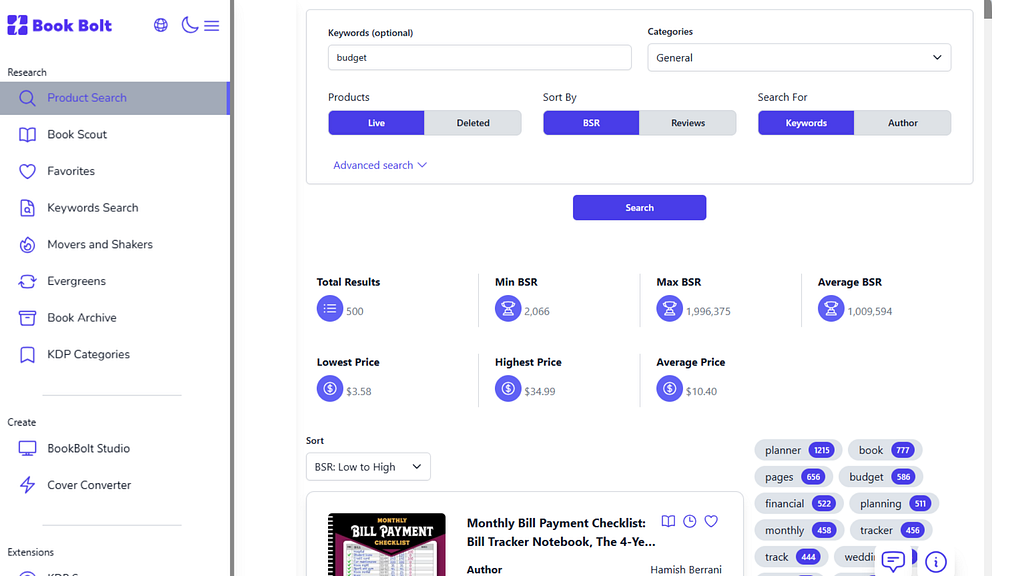
What you’re looking for:
You want books that already sell but aren’t too competitive. The best opportunities are usually simple ideas with steady demand and repeat potential.
Look for things like low-competition niches, consistent search interest, and products that solve everyday needs.
Examples:
- Fitness trackers
- Gratitude journals
- Budget planners
You can also explore seasonal ideas, such as wedding planners in spring or holiday journals in winter, but those work best once you understand evergreen demand first.
💡 Pro tip: Focus on evergreen niches first. They give you more stability and make it easier to build momentum before testing seasonal trends.
Step 2: Design Your Interior
Now you’re moving from idea to actual product. Inside Book Bolt Studio, this is where your book starts coming together in a real, usable format.
How to start:
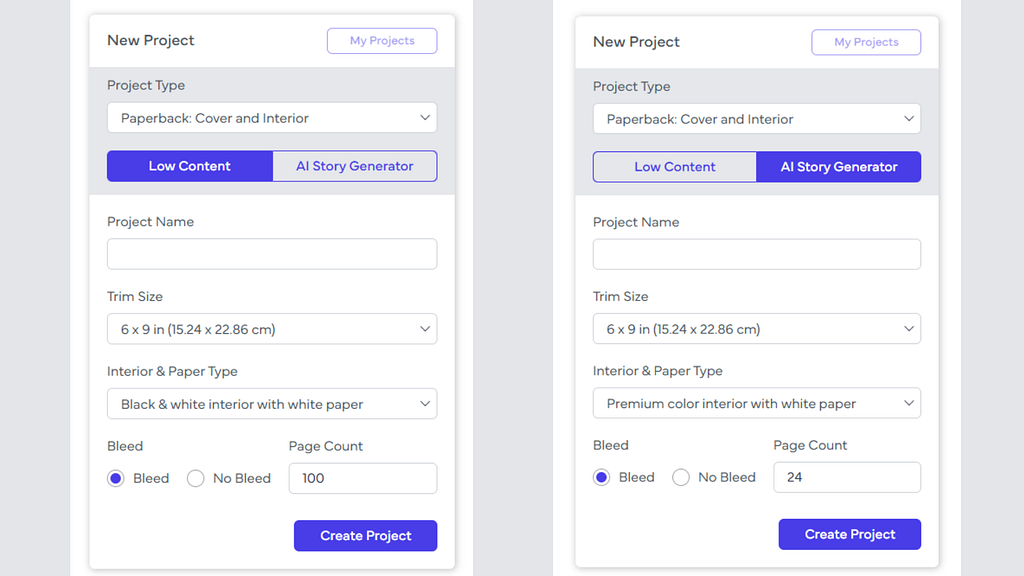
Go to the “Create” section and open Book Bolt Studio. When the New Project window appears, set up your project step by step:
Project Type: You’ll see several options like Paperback: Cover and Interior, Paperback: Cover, Paperback: Interior, Hardcover variations, and Custom. For journals and most low-content books, choose “Paperback: Cover and Interior” so you can design both the inside pages and the cover in one project.
You’ll also notice an AI Story Generator option. This is useful if you want Book Bolt to generate content for you automatically. For example, it may prefill settings like:
- Paperback: Cover and Interior
- 6 × 9 in (15.24 × 22.86 cm)
- Premium color interior with white paper
- Around 24 pages
This can be a quick way to create simple books, especially if you’re experimenting or want a faster starting point.
Trim Size: Select 6 × 9 inches, which is the most common and beginner-friendly size.
Page Count: Set it between 100 and 120 pages to balance value and printing cost.
Bleed Setting: Choose No Bleed for simple interiors like lined or planner pages. Choose Bleed only if your design goes all the way to the edge of the page.
Project Name: Give your file a clear name like “Gratitude Journal 6x9” so it saves and stays organized.
Once everything is set, click “Create Project,” and you’re ready to start designing.
What you can build:
Inside the studio, you can use ready-made templates or create your own layouts. Common options include:
- Lined or dotted pages
- Habit trackers
- Daily planners
- Budget sheets
- Puzzle or coloring pages
You can mix different page types or keep it simple with one consistent layout.
Design tips:
Keep designs simple and consistent, so the book feels easy to use. Stay within margins to avoid printing issues, and use black text on a white background to keep production clean and cost-effective.
Simple wins here.
Step 3: Design a Cover That Gets Clicks
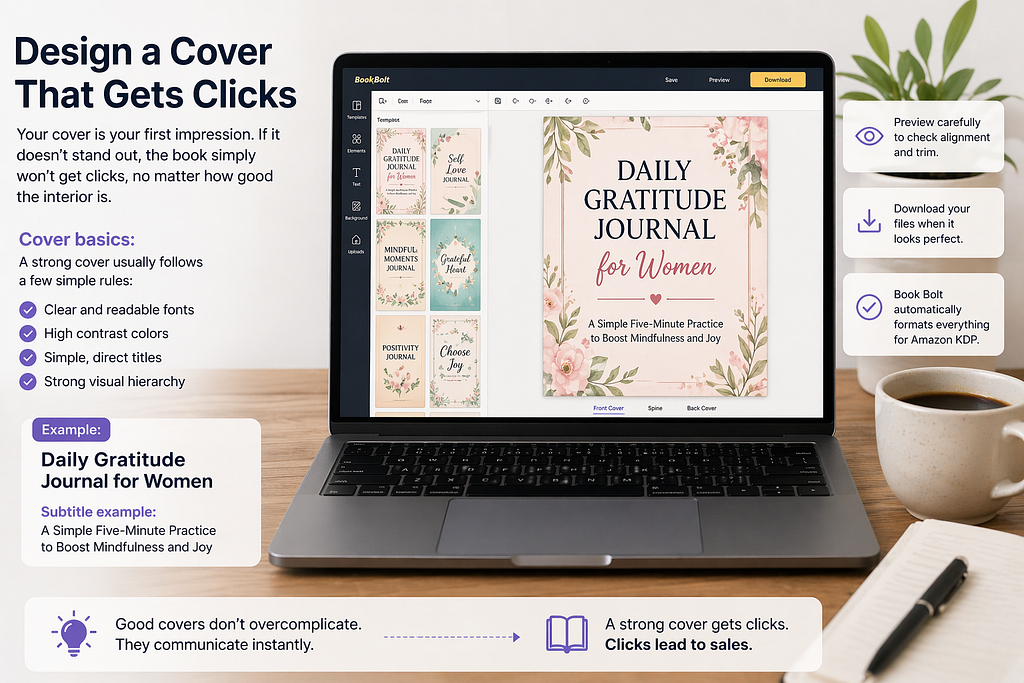
Your cover is your first impression. If it doesn’t stand out, the book simply won’t get clicks, no matter how good the interior is.
Inside Book Bolt, you can design covers using templates that already match Amazon’s required sizes.
Cover basics:
A strong cover usually follows a few simple rules:
- Clear and readable fonts
- High contrast colors
- Simple, direct titles
- Strong visual hierarchy
Example:
Daily Gratitude Journal for Women
Subtitle example:
A Simple Five-Minute Practice to Boost Mindfulness and Joy
Good covers don’t overcomplicate. They communicate instantly.
Before exporting, preview everything carefully to make sure alignment is correct and nothing is cut off. Once it looks right, download your files. The platform automatically formats everything for Amazon KDP, so you’re ready for upload without extra steps.
Become A Published Author On Amazon With Zero Upfront Costs
Step 4: Optimize Your Listing for Search
Even a great book won’t sell if nobody can find it. This is where keywords make a real difference.
Book Bolt includes keyword tools that help you see what people are actually searching for on Amazon.
What to do:
Start by finding keywords with medium competition. These are usually the sweet spots where demand exists, but the market is not too crowded.
Then:
- Add 1 to 2 main keywords in your title
- Use supporting keywords naturally in your description
Example:
Title: Daily Gratitude Journal for Busy Moms
Subtitle: A Simple Five-Minute Practice to Boost Mindfulness and Joy
Description:
Start your day with intention and gratitude using this simple guided journal designed for busy moms…
Pro tip: Save your keyword lists inside Book Bolt so you can reuse them when creating related books in the same niche.
Step 5: Upload to Amazon KDP
Once everything is ready, it’s time to publish.
Publishing steps:
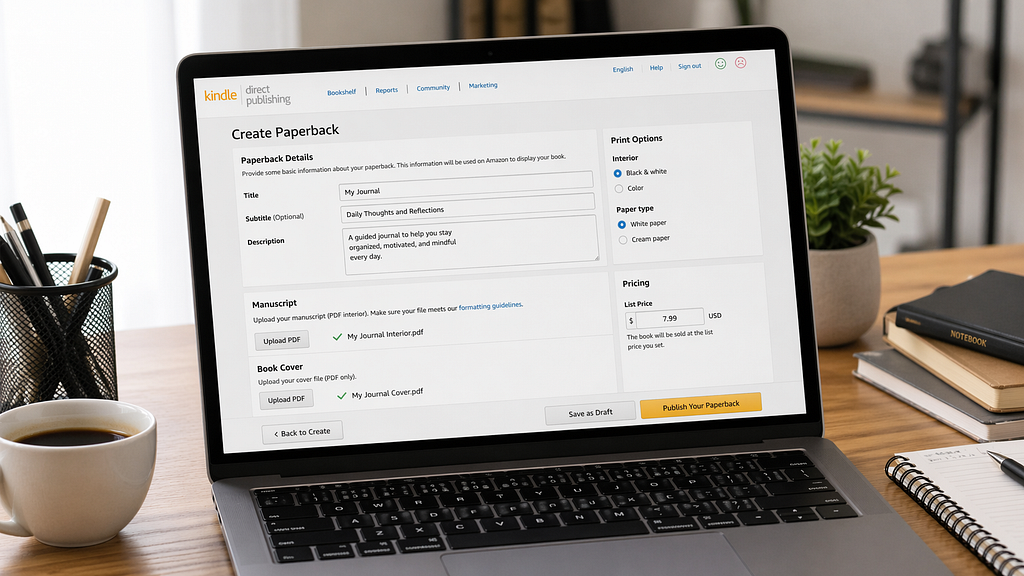
Click Create Paperback, then enter your book details like title, subtitle, and description. Upload your interior PDF and cover PDF, then choose a Black and White interior with white paper for most low-content books.
Set your price, usually between $6.99 and $9.99 for journals and similar products.
Amazon will review your file, which usually takes around 72 hours. Once approved, your book goes live on the platform.
And just like that, you’ve turned a simple idea into a product on Amazon.
What Makes This Model Work
This isn’t about writing books. It’s about building simple, useful products that people already use every day.
It works because:
- There’s no inventory involved
- Startup costs are low
- Demand is consistent and evergreen
- The process is easy to repeat and scale
You create the product once. Amazon handles printing, shipping, and delivery.
Scaling Beyond Your First Book
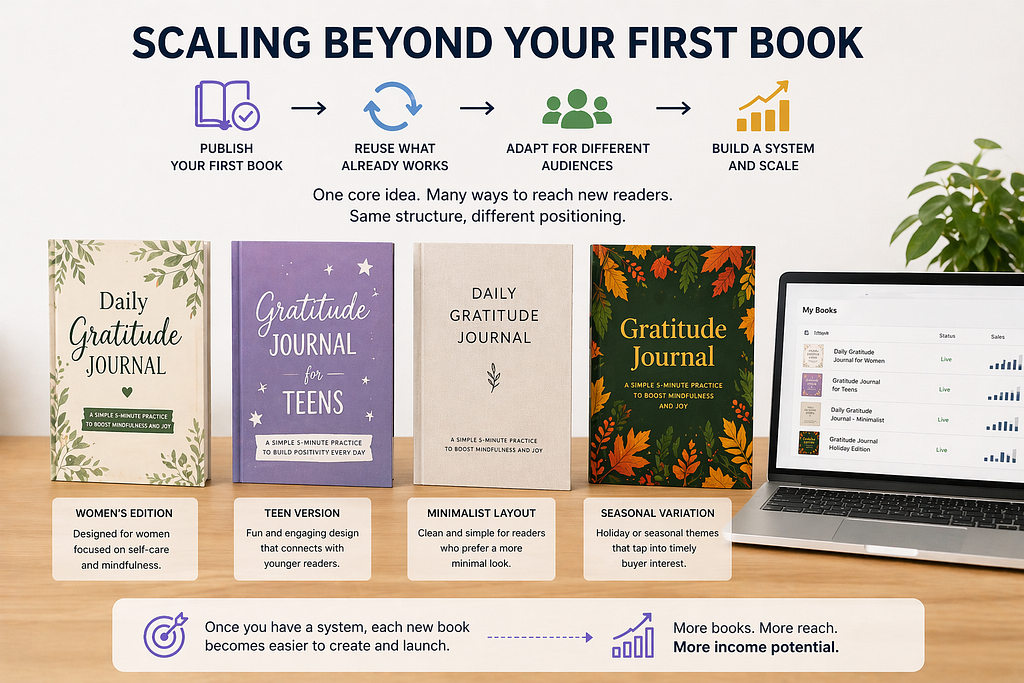
Once you’ve published your first book, the real advantage comes from repetition. The process doesn’t change much, and that’s the point. Instead of treating each book as a one-off project, you start building a system where each new book becomes easier to create than the last.
Scaling usually starts by reusing what already works. You can take a successful interior and simply change the cover, or adjust the theme to target a different audience. Over time, this turns into creating variations of the same core idea rather than starting from scratch every time.
For example, a single journal concept can be expanded into multiple versions aimed at different groups. A women’s edition, a teen version, a minimalist layout, or even a seasonal holiday variation all use the same structure but speak to slightly different buyers. The product stays familiar, but the positioning changes, which is often enough to reach new audiences.
Pro Tips for Long-Term Results
As you become more comfortable with the process, it starts to feel less like individual book creation and more like building a repeatable publishing system. At that point, consistency matters more than complexity.
Many creators begin organizing their work into simple series, often releasing books as Volume 1, Volume 2, and Volume 3. Others experiment with seasonal ideas or test puzzle-based interiors to keep their catalog varied while still staying within the same niche direction. What matters most is that you’re building momentum over time instead of stopping after a single upload.
It also helps to keep track of what is working. A simple spreadsheet with niches, keywords, and performance notes can reveal patterns you might otherwise miss. Over time, this becomes your own data-driven roadmap for what to create next.
Inside Book Bolt, you can also explore AI-assisted tools for creating children’s books and illustrations, which opens up another layer of expansion once you’ve mastered the basics.
Common Mistakes to Avoid
There are a few patterns that quietly hold people back when they start with Amazon KDP, and most of them come down to approach rather than the platform itself.
One of the biggest mistakes is skipping research and jumping straight into creating a book based on assumptions. It might feel faster in the moment, but it usually leads to products that don’t match what people are actually searching for. Another common issue is overcomplicating the design. Low-content books perform best when they are simple, clean, and easy to use, but beginners often add unnecessary elements that reduce clarity.
A few other mistakes tend to show up consistently:
- Weak or unclear covers that fail to attract clicks
- Choosing overly saturated niches with too much competition
- Publishing once and stopping instead of building consistency
Each of these slows progress more than most people realize, especially early on when momentum matters.
In the end, success in this space is less about getting everything perfect and more about staying consistent. The people who keep going usually outperform those who try to make everything flawless from the start.
Create & Publish Your Own Story Book On Amazon KDP (In The Next 15 Minutes)
Conclusion
You start with curiosity. Just a small idea that this might be worth exploring.
Then something shifts.
This isn’t about being a writer or mastering complicated publishing skills. It’s about creating simple, useful products that people are already searching for and buying every day on Amazon.
Tools like Book Bolt don’t guarantee results. What they do is remove the friction that usually stops most people from starting in the first place, the guessing, the overwhelm, and the technical confusion.
And sometimes, that’s the real difference. Not doing everything perfectly, just finally starting in a way that feels doable.
If you want to explore the system yourself and see how the process actually works in practice, you can start with the Book Bolt KDP toolkit here.
Follow for more practical tools, strategies, and AI insights designed to help creators and entrepreneurs work smarter and build more efficient digital workflows.


