What to set up before you hit swap, and what to fix when the result isn’t right.
This is a members-only story, but non-members can read it for free here
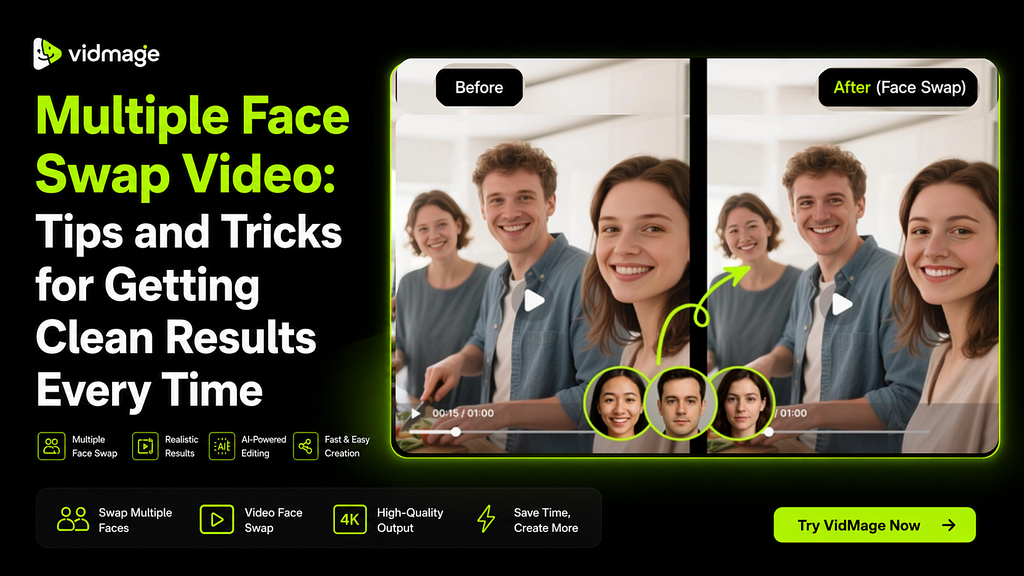
Swapping one face in a video is straightforward enough. Swapping two, three, or four faces in the same clip at the same time is a different challenge, and most tools don’t make it easy to understand why results vary or what to do when something looks off.
This guide is built around the practical side of multiple face swap video editing: what affects the output, how to set your clips and reference photos up for the best result, and how VidMage handles the parts that trip people up most often. You can follow along directly at multiple face swap video AI while you read.
Start With the Right Video: What the AI Actually Needs
Before any face swap happens, the AI has to detect and track every face in your clip. The cleaner it can do that, the better the final result.
Lighting is the single biggest variable. Consistent lighting across the whole clip gives the AI a stable reference point for each face. If the lighting shifts mid-video, like someone walking from a bright window into a shadowed area, the AI has to compensate on every frame, and the blend gets harder to keep natural. If you have any control over the source clip, steady, even lighting makes everything downstream easier.
Faces need screen time. VidMage tracks faces across every frame of the clip, but it can only work with what it can see. If a face disappears from frame for long stretches, cuts away, or is obscured for much of the clip, the tracking has less to work with. Clips where each person’s face is visible and forward-facing for most of the video give the cleanest output.
Shorter clips process faster and more consistently. The free plan supports clips up to 100MB and 15 seconds. Within that window, a tight, well-lit clip will almost always outperform a longer one with more variation in lighting or movement.
Choosing the Right Reference Photo for Each Person
The reference photo is doing a lot of work in a multiple-face swap video. The AI uses it to understand the face structure, skin tone, and lighting direction it’s trying to reproduce across every frame of your clip.
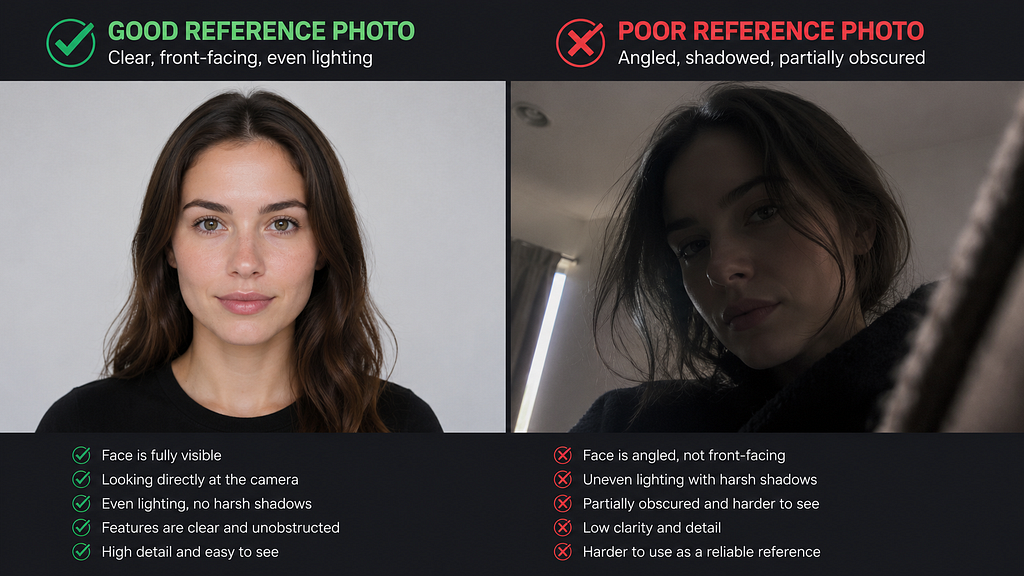
A few things that make a real difference:
Front-facing photos work best. A slight angle is fine, but the more directly the face in the reference photo faces the camera, the more accurately the AI can map it onto the faces in the video. Profile shots or heavily angled photos give the AI less to work with.
Match the lighting where you can. If your video was shot in warm indoor light and your reference photo was taken outside in bright daylight, the skin tones are going to be harder to blend convincingly. It doesn’t have to be a perfect match, but closer is always better.
Use a clean, uncluttered photo. Sunglasses, hats, hair falling across the face, or other people partially in frame all make face detection harder. A clear photo where the face is fully visible and well-lit, gives VidMage the best possible starting point.
One photo per person, matched to each face. VidMage lets you upload up to four reference photos and map each one to a specific detected face in the video. Take your time with the mapping step. Assigning the wrong reference to the wrong face is the most common reason a multi-face swap looks wrong, and it’s the easiest thing to fix before you hit the swap button.
Handling Overlap and Partial Obstructions
Group videos almost always have moments where faces overlap, someone turns away, or part of a face goes out of frame. Here’s how to think about each situation.
Overlapping faces. When two people’s faces are close together or partially overlapping in the frame, the AI has to work harder to separate the edge of one face from the other. VidMage handles this reasonably well, but if you’re getting blurry or bleeding edges on overlapping faces, try a clip where the subjects are slightly more separated in frame.
Faces that turn away mid-clip. The AI tracks faces through natural movement, including head turns, but a full 180-degree turn where the face completely disappears is a hard cutoff. For clips with a lot of turning, the result is usually still good on the frames where the face is visible. The more the face stays forward-facing throughout, the more consistent the tracking.
Partial obstructions like hands or objects. If someone covers part of their face mid-clip (a common thing in group videos where people gesture or laugh), the AI fills in based on the surrounding frames. Usually, this is seamless. For very long or very sudden obstructions, a clip where hands and objects stay out of the face area will give you a cleaner result.
The Mapping Step: Don’t Skip It
One of the things that separates VidMage from tools that just swap every detected face automatically is the mapping step. Before the swap runs, you match each reference photo to a specific face in the video. You can also leave certain faces unmapped, which means they stay exactly as they were filmed.
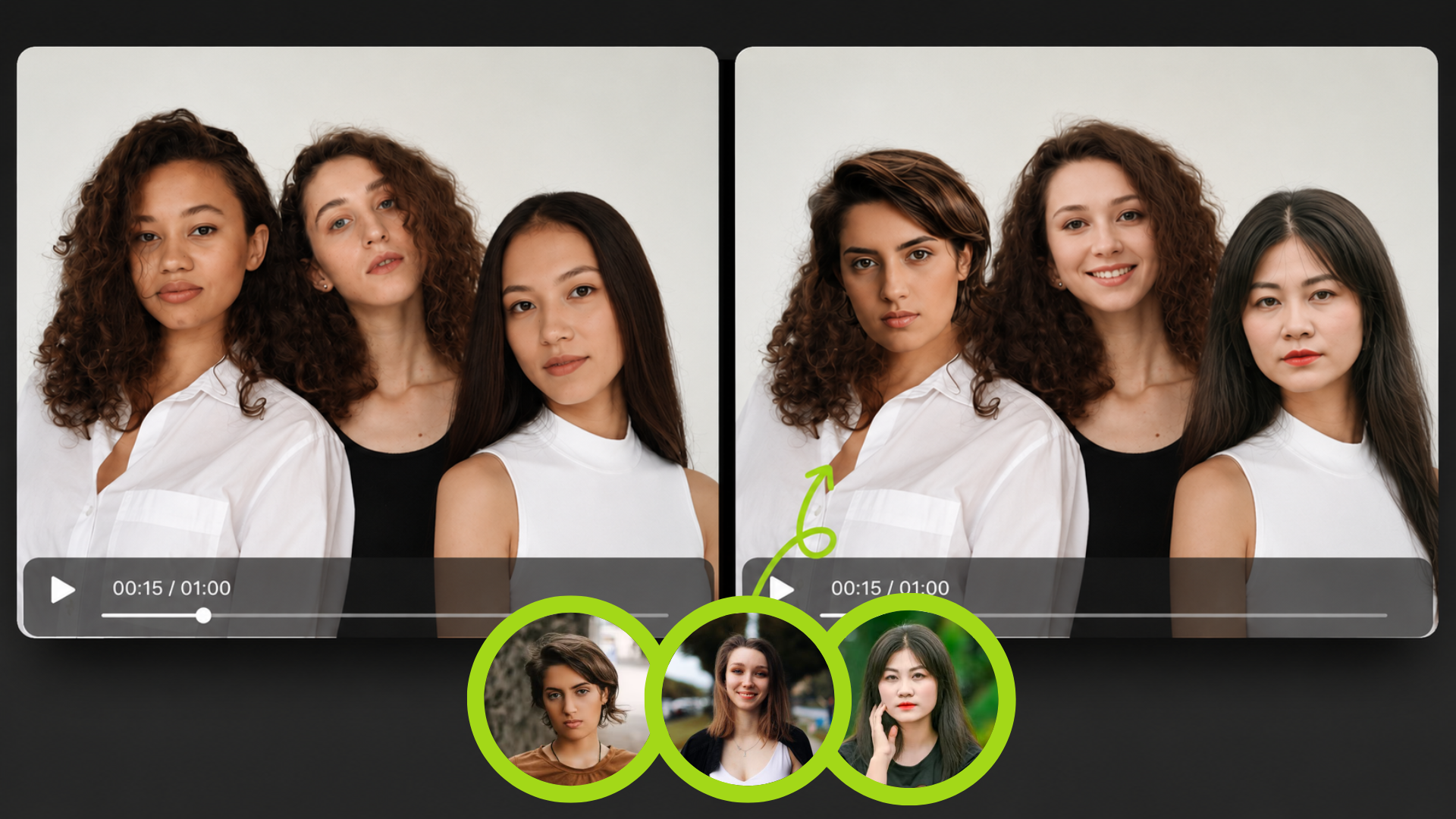
This matters more than it sounds. In a group video, you might want to swap three faces and leave one unchanged, or swap only the people on one side of the frame. The mapping step gives you that control without any additional editing afterward.
Take an extra thirty seconds here to make sure each reference photo is matched to the right person. It’s the easiest place to catch a mismatch before it becomes a problem in the final output.
What to Do If the First Result Isn’t Right
Multi-face swaps don’t always land perfectly on the first try, and that’s normal. A few quick checks usually identify the issue.
If one face looks noticeably worse than the others, the reference photo for that person is usually the culprit. Swap it for a clearer, more front-facing photo and run it again.
If the blending looks consistent but slightly off across all faces, the lighting in the source clip is probably shifting. A clip with steadier lighting will fix this more reliably than changing the reference photos.
If a mapped face isn’t being swapped at all, check that the face detection picked it up correctly during the mapping step. Sometimes a face that’s at an angle or partially lit gets missed. Adjust the mapping and try again.
Privacy in One Line
VidMage deletes all uploaded videos and face photos within two hours, uses no content for AI training, and offers a fully offline Mac app for anyone who’d rather keep everything local. Full details are at multiple face swap video AI.
The Inputs Decide the Output
Multiple face swap video editing has a reputation for being unpredictable, but most of the variation comes from a handful of controllable factors: lighting in the source clip, quality of the reference photos, and the care taken during the mapping step. Get those three things right, and the output is consistently clean.
VidMage handles the heavy lifting once the inputs are solid. The tool is free to use, runs entirely in the browser, and produces 1080p results with no watermark. Once you understand what it responds well to, the whole process gets a lot more repeatable.
Ready to try it on your own group clip? Head over to the multiple face swap video AI tool. Set up your reference photos carefully, take your time with the mapping step, and the rest is easier than you’d expect.
Follow for more practical tools, growth strategies, and AI insights designed to help entrepreneurs build smarter businesses.


